Xinhua
06 Oct 2025, 11:15 GMT+10
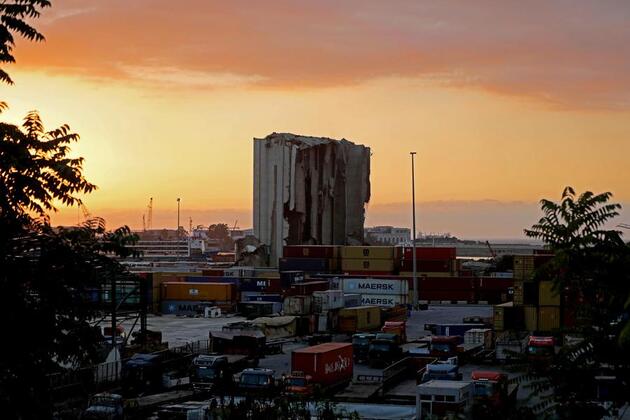
Five years after the Beirut port explosion, the grain silo that took the brunt of the blast and shielded half the city from greater ruin still stands -- scarred, silent, and monumental.
by Dana Halawi
BEIRUT, Oct. 6 (Xinhua) -- Beirut is a city that wears its wounds in plain sight. Walk down many streets in the Lebanese capital, and you can still trace the outlines of old battles: bullet holes from a civil war that ended more than three decades ago, or facades scarred by recent clashes with Israel. But no scar is as visible -- or as heavy -- as the one left by the explosion at the port five years ago.
You could be strolling through the trendy downtown district, passing gleaming high-rises and sidewalk cafes that wouldn't look out of place in a European capital. But shift your gaze toward the shoreline and there it is: the ruined port, dominated by the grain silo. Broken and tilted, somehow still standing after the blast, it seems to defy gravity and time, watching over the city in stark silence.
On the afternoon of Aug. 4, 2020, almost 3,000 tonnes of ammonium nitrate stored at the port ignited. The explosion killed more than 200 people, injured thousands, and tore open the heart of Beirut. The blast registered as a 3.3-magnitude earthquake and has been called one of the largest non-nuclear explosions in human history.
From her apartment overlooking the port, Rima Hocheimy cannot glance at the silo without feeling her chest tighten. It is too much at once -- monument and wound, shield and scar.
The shockwave that day tore through her home, scattering glass and splintered wood, collapsing the small ordinariness of a peaceful afternoon into a before and after. Her mother and young son, Elia, were hurt. Yet the silo's massive walls, built to store grain, absorbed much of the force, shielding half the city from even worse devastation. Experts later said that without the silo, Beirut's losses would have been even greater.
"I don't know what I feel about that silo," Rima said, watching Elia play quietly nearby. "It reminds me constantly of the horror we lived through. But I also know it saved my family. I can't bear to think what would have happened without it."
Elia was only four at the time, and the trauma lingered for months. He woke from nightmares, wet the bed, and clung to his mother in fear of the dark. Even now, at nine, he startles at loud noises, his anxiety rising with every burst of commotion -- which, in Beirut, is never far away.
"When the Israeli strikes came last year -- all those planes and drones and bombs -- it brought everything back for him," Rima said.
She understands. Born during Lebanon's civil war, she has spent her life bracing for the next rupture. "Our house is rebuilt, but safety never returned. Some cracks never heal."
Like Rima's family, the entire city remains caught between recovery and trauma. Five years later, Beirut is a patchwork of progress and abandonment. On one block, you might see a freshly restored building, its walls bright and new. Right beside it, another house sits in ruins, windows blown out, forgotten.
Authorities say nearly 8,000 buildings were damaged, while dozens of historic landmarks are now at risk of collapse. Reconstruction has moved forward in places, but shortages of funding and ongoing instability, among other obstacles, have slowed the effort at every turn.
Accountability has fared even worse. The blast was more than an accident. Instead, it was the consequence of years of neglect and institutional failure. Thousands of tons of dangerous chemicals sat in the port for years, ignored by officials across multiple agencies. Everyone knew. No one acted. To this day, no one has been held accountable.
The investigation has been stalled repeatedly by political interference, legal challenges, and the removal of lead judges. Families of the victims are still waiting for answers.
Trust in the government shattered along with the windows that August afternoon. Leaders have promised justice, but observers and grassroots groups insist that only a fair, independent inquiry can begin to close the wound.
On the eve of the fifth anniversary this summer, a road near the port's entrance was renamed the Street of the Victims of August 4. Standing there among the crowd, I saw faces lined with sorrow but lit with resolve. Their quiet presence spoke of wounds that have yet to heal, and of a determination for accountability that refuses to fade.
And still, the silo looms. In 2022, the government announced plans to demolish it over safety concerns, but backlash from victims' families forced a pause. To them, it must remain -- a memorial as much as a ruin. Engineers warn the structure could collapse at any moment. Yet it stands.
Perhaps it waits for Lebanon to decide how to honor its dead, how to build something stronger from the ruins. Perhaps we all do.
Get a daily dose of Poland Sun news through our daily email, its complimentary and keeps you fully up to date with world and business news as well.
Publish news of your business, community or sports group, personnel appointments, major event and more by submitting a news release to Poland Sun.
More InformationDUBLIN, Ireland: An Garda Síochána spent 590,000 euros on hotel accommodation for members policing the 2024 UEFA Europa League final...
MONTREAL, Canada: Air Canada is turning to complimentary alcohol in economy class as a way to stand out and soothe passengers who are...
DUBLIN, Ireland: Convicted transgender prisoner Barbie Kardashian, described in court as posing a significant threat to the public,...
DUBLIN, Ireland: Taoiseach Micheál Martin has said it makes sense to offer financial support to international protection applicants...
Five years after the Beirut port explosion, the grain silo that took the brunt of the blast and shielded half the city from greater...
COIMBRA, 6th October, 2025 (WAM) -- Ahmed bin Rakkad Al Ameri, CEO of the Sharjah Book Authority (SBA), recently announced the opening...
SAN FRANCISCO, California: The parents of a 19-year-old college student killed in a Tesla crash have filed a lawsuit claiming she was...
WASHINGTON, D.C.: On the morning of October 2, as thousands of federal employees remained at home facing furloughs and the looming...
NEW YORK CITY, New York: A new PEN America report paints a stark picture of the ongoing book censorship battle in U.S. schools, revealing...
WASHINGTON, D.C.: The White House is pressuring nine major universities to sign onto President Donald Trump's political priorities...
LONDON, U.K.: Britain's Supreme Court ruled in April that under equality laws, sex refers to biological sex, meaning transgender women...
Tel Aviv [Israel], October 4 (ANI): Soon after Hamas signalled its willingness to accept United States President Donald Trump's Gaza...